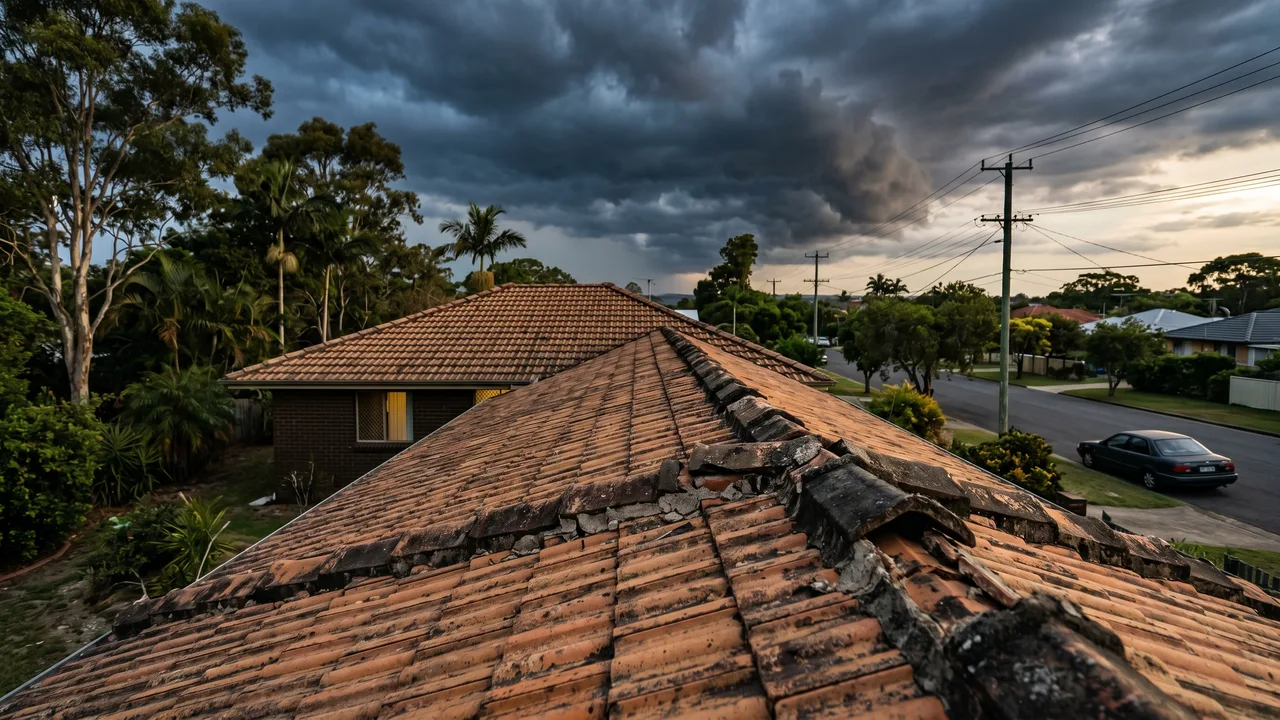
Roof Restoration guide
How Storm Season Should Shape Your Roof Restoration Decision
How Storm Season Should Shape Your Roof Restoration Decision
Storm season should influence when you restore your roof, not just whether you do it. If your roof has underlying problems, a Queensland storm will find them fast. The question is whether you discover those problems on your own terms, or through a soggy ceiling at 2 am in January.
What Brisbane's Storm Season Actually Does to a Roof
South-east Queensland's storm season typically runs from October through to March. For suburbs like Wynnum, Manly and Lota, that window also coincides with salt-laden onshore winds off Moreton Bay. That combination of wind-driven rain, hail, UV heat and coastal salt air is harder on a roof than most people appreciate.
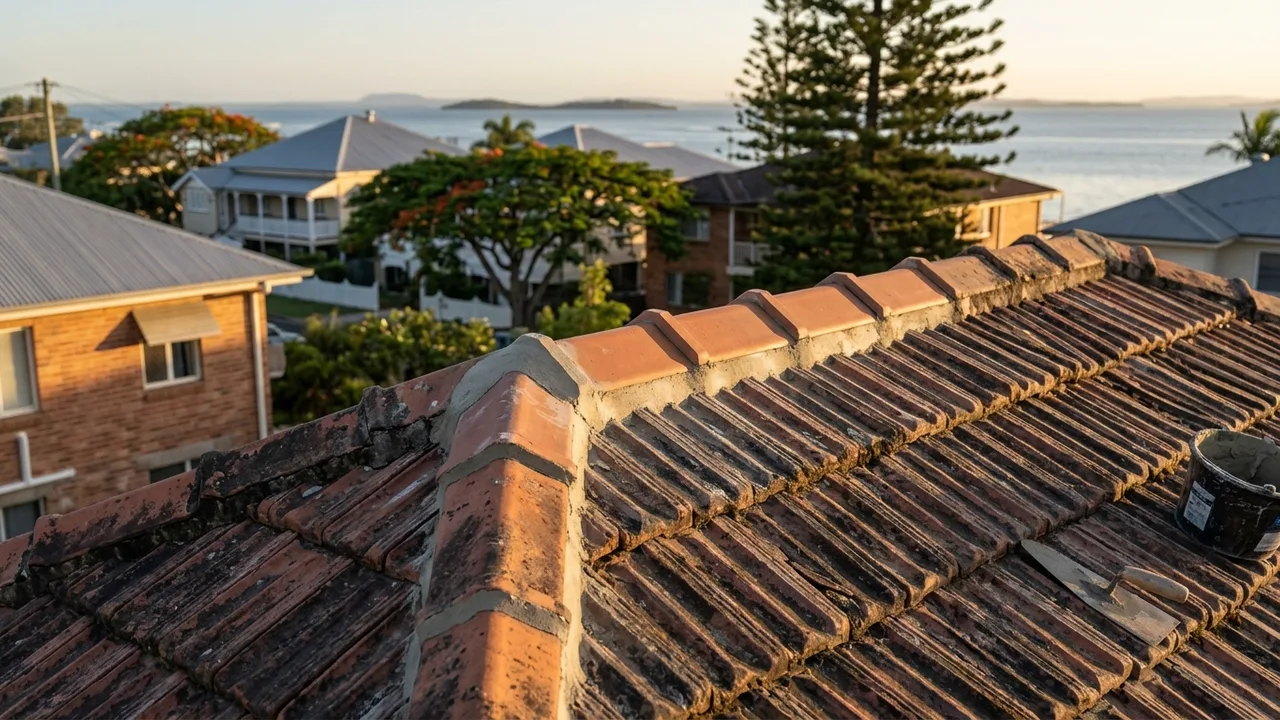
Here is what typically happens during that period:
- Wind works at loose ridge caps and any pointing that has already started to crack. A tile that was borderline in September can become a leak in November.
- Hail chips terracotta and concrete tiles, and puts dents in older Colorbond or corrugated iron that can compromise the protective coating.
- Heavy rain drives water sideways through gaps you would never notice in a light shower. Flashings around chimneys, skylights and roof penetrations are the usual entry points.
- Heat and UV between storms continue to degrade sealants, membranes and pointing compound, making them brittle and prone to cracking.
- Salt air (particularly relevant for Wynnum, Manly and Hemmant, being close to the bay) accelerates corrosion on metal flashings, gutter fixings and any exposed steel components.
For older Queenslander-style homes with terracotta tiles and lime mortar pointing, the risk during storm season is especially real. That mortar can be decades old and may look solid from the ground while being quite fragile.
The Timing Question: Before, During or After Storm Season?
This is where most homeowners get stuck. The honest answer involves a trade-off.
Before storm season (July to September) is generally the best window. Tradespeople are easier to book, the roof is dry enough to work on safely, and any repairs have time to cure properly before the first big storm hits. Sealants and pointing compounds typically need several days of dry weather to set correctly, so the dry Brisbane winter gives you that margin.
During storm season is risky for scheduling. Rain delays are common, and reputable operators will not apply coatings to a wet or damp surface. If you have an active leak, temporary repairs can be done quickly, but a full restoration mid-storm season is difficult to time well. Demand also spikes after major events, so wait times can stretch out.
After storm season (March to June) is a reasonable fallback if you missed the ideal window. You can assess what the season actually did to your roof and make informed decisions about the scope of work needed. Many homeowners in Wynnum West and Manly West use this period to get a proper inspection done and plan work for the following winter.
The trade-off is straightforward: acting before storm season costs the same money but gives you protection during the most damaging period. Waiting until after means you carry the risk through the season, but you make decisions based on real evidence rather than guesswork.
Which Roof Conditions Make Storms a Genuine Threat
Not every roof needs a full restoration before October. The honest question is what condition your roof is actually in.
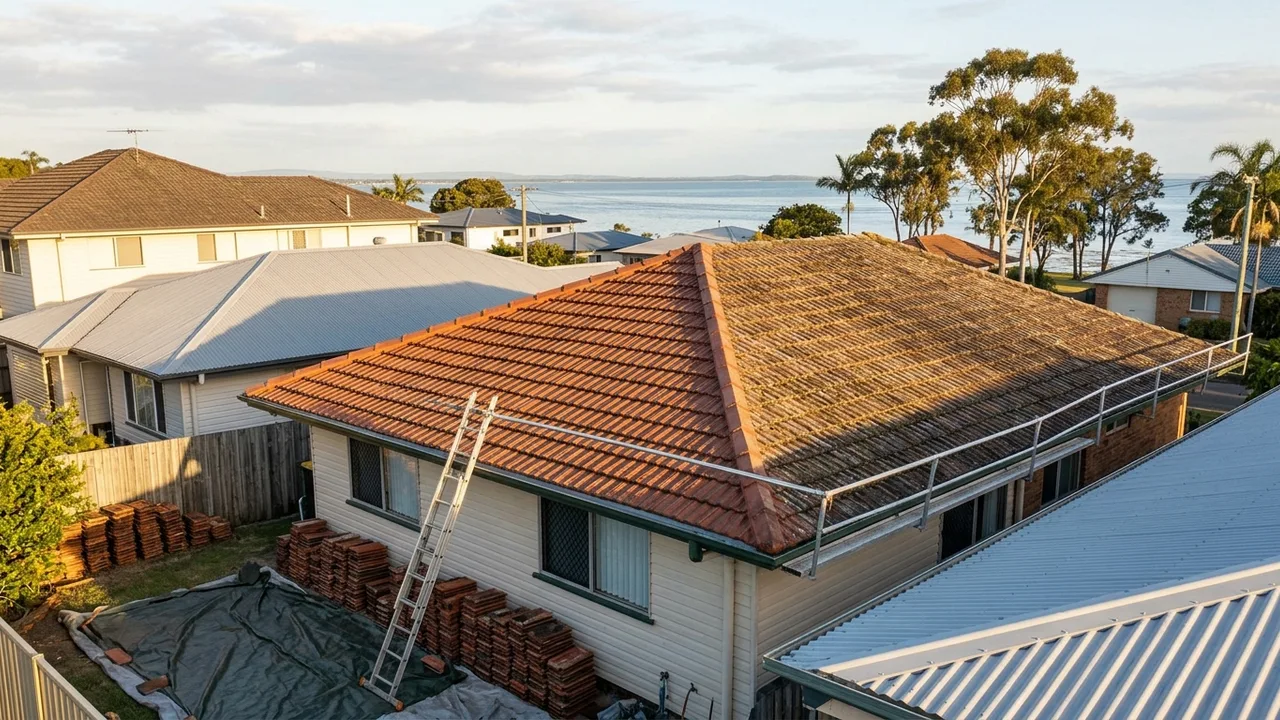
Signs that storm season poses a real risk to your specific roof:
- Cracked or missing pointing on ridge caps. This is the single most common entry point for water during driving rain. You can often see it from the ground with binoculars on a bright day.
- Loose or displaced ridge caps. If any have shifted even slightly, wind can pop them completely in a severe storm.
- Cracked or slipped tiles. One cracked tile in a high-exposure location (a ridge, a hip end, or directly below a valley) can let in a surprising amount of water.
- Visible rust or lifting on flashings. Flashings around chimneys and vents are often the first things to fail, and they are cheap to fix before they cause serious internal damage.
- Gutters that are sagging, leaking at joints or pulling away from fascia. In a heavy downpour, a failed gutter can send water directly into your eaves and wall cavity.
- A roof that has not been cleaned or sealed in more than ten years. Lichen and moss hold moisture against tiles and accelerate their breakdown. A pressure clean followed by a protective coat is often enough to buy several more good years.
If your roof has none of these issues, you may not need to act urgently. A professional inspection, which most local operators will do for a modest fee or as part of a quote, gives you a clear picture.
Full Restoration vs Targeted Repairs: Choosing the Right Scope
A full roof restoration, covering pressure cleaning, tile repairs, re-bedding, re-pointing and a protective recoat, typically costs between $3,000 and $12,000 in the Brisbane bayside area depending on roof size, pitch and condition. That is a meaningful investment and not always necessary.
Targeted repairs, replacing a handful of cracked tiles, re-pointing a section of ridge capping, or resealing a flashing, can often be done for several hundred dollars and will solve an immediate problem.
The trade-off comes down to the age and overall condition of the roof:
- If the roof is generally sound but has one or two specific failure points, targeted repairs make sense. Fix what is broken, leave what is working.
- If the pointing is cracking across most of the ridge line, the tiles are porous and starting to lift their coating, and the gutters are marginal, a full restoration is more cost-effective over a five to ten year horizon. Doing individual repairs on a broadly deteriorating roof is often a case of treating symptoms rather than the underlying condition.
- A pressure clean and recoat without the full repair scope is sometimes the right middle-ground for a roof that is structurally sound but has lost its protective finish. This is typically the lower end of the cost range.
Ask any operator you speak with to explain clearly which category your roof falls into and why. A straightforward answer to that question tells you a lot about how they work.
What to Expect from the Restoration Process Around Storm Season
If you decide to move ahead before storm season, here is a rough picture of how the process typically unfolds for a standard tile roof in Wynnum or Manly:
- Inspection and quote. A thorough walk of the roof, noting cracked tiles, ridge cap condition, flashing integrity and gutter state.
- Pressure cleaning. Removes lichen, moss, dirt and loose material. The roof needs to be fully dry before the next step, so allow a day or two depending on conditions.
- Tile and flashing repairs. Cracked or broken tiles replaced, flashings resealed or replaced.
- Re-bedding and re-pointing. Loose ridge caps are re-set in fresh mortar (bedding) and covered with flexible pointing compound. This is the step that most directly protects against storm water entry.
- Protective coat. A sealant or membrane coat applied to the whole tile surface. This step is weather-sensitive and needs consecutive dry days.
From start to finish, a full restoration on a typical three-bedroom Wynnum home is usually completed in two to four days of actual work, though scheduling gaps between steps can stretch the calendar timeline.
A Sensible Way to Make Your Decision
Take a pair of binoculars and spend ten minutes looking at your ridge line, your valleys and around any penetrations. If you can see cracked pointing, displaced caps or damaged tiles, get a proper inspection before October. The cost of a professional assessment is small relative to the cost of storm damage repair through your insurer, which typically involves excess payments, wait times and the stress of a wet house.
If everything looks intact and the roof is less than ten years past its last restoration, monitor it through the season and plan ahead for next winter.
If you are not sure what you are looking at from the ground, that is a reasonable prompt to get someone up there to have a proper look. Most homeowners in Wynnum and surrounds only think seriously about their roof twice: before a storm, and after one. The first option is considerably less expensive.
If you would like to be connected with a local operator who works across Wynnum, Manly, Lota, Hemmant and the surrounding suburbs, you can contact us and we will pass your details to someone appropriate. We are a referral service, not a roofing company ourselves, but we only work with operators who are local, licensed and carry the right insurance.
Quick answers