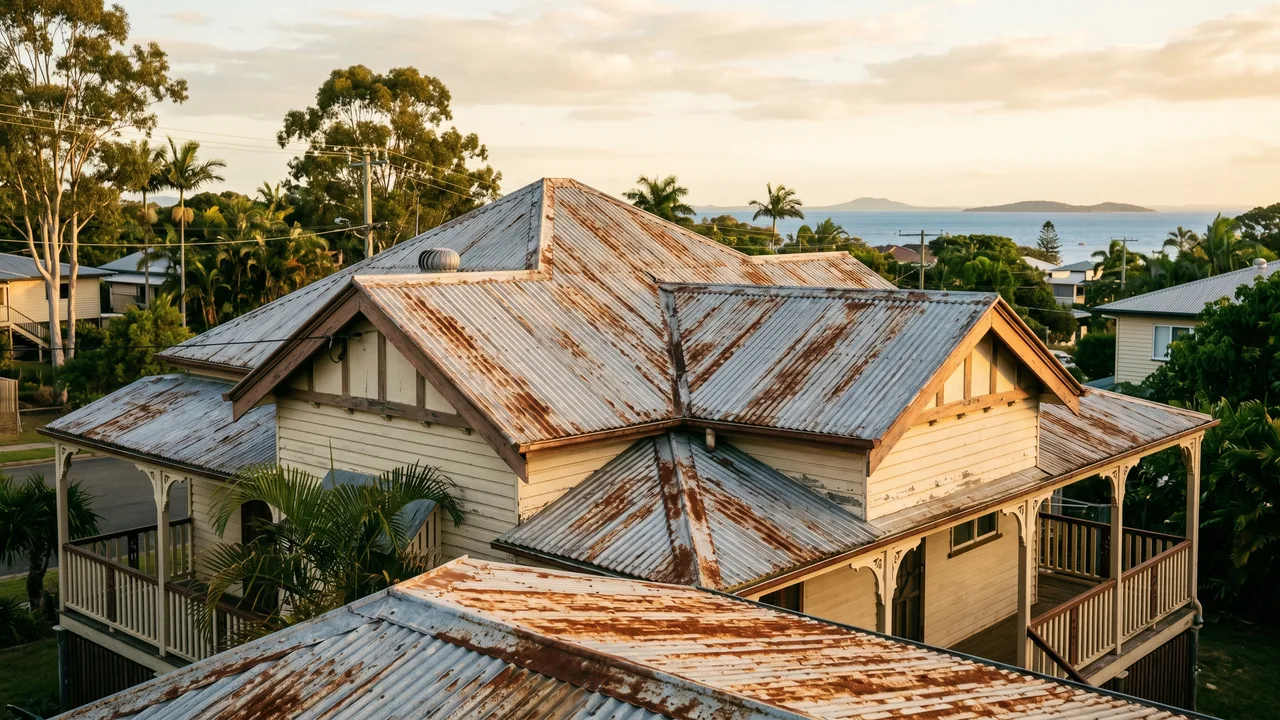
Roof Restoration guide
Does Living Near the Bay Accelerate Roof Deterioration?
Does Living Near the Bay Accelerate Roof Deterioration?
Yes, it does. Salt-laden air is genuinely harder on roofing materials than the air further inland, and the suburbs closest to Moreton Bay, including Wynnum, Manly and Lota, sit squarely in that zone. How much harder depends on your roof type, its age, and how well it has been maintained.
That said, "accelerate" does not mean your roof is doomed. It means the maintenance timeline is shorter and the consequences of neglect arrive faster. Understanding exactly what is happening up there helps you make smarter decisions about when to act and what to spend.
What Salt Air Actually Does to a Roof
The mechanism is straightforward. Sea breezes carry microscopic salt particles inland from the bay. Those particles land on your roof surface and, when moisture follows (dew, light rain, humidity), they form a mild saline solution. That solution sits against metal, tiles and mortar while the sun dries it back to a crystalline deposit. Then the next coastal breeze drops more salt, and the cycle repeats.
For metal roofing, including Colorbond and older corrugated iron, this process accelerates oxidation. In practical terms, you will typically see surface rust on uncoated fixings and screws well before you see it on the sheeting itself. Fasteners are the early warning sign most people miss.
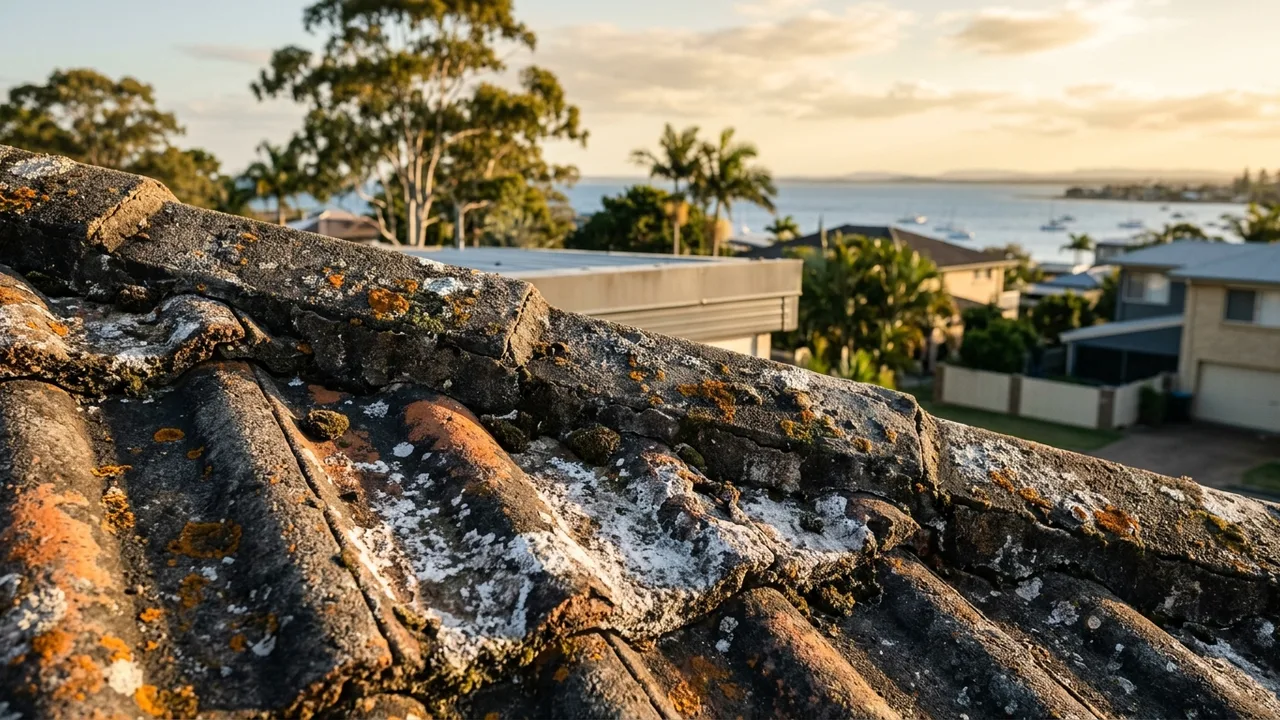
For terracotta and concrete roof tiles, the damage shows up differently. Salt does not rust a tile, but it does attack the mortar and pointing compound around ridge cappings. Mortar is porous; it absorbs moisture, and dissolved salt crystals expand slightly as they dry inside the pores. Over years, that physical pressure fractures the mortar from within. You end up with crumbling ridge pointing that lets water into the roof cavity, often long before any tile itself cracks.
Timber elements, particularly fascia boards on older Queenslander-style homes, are also vulnerable. Salt and humidity together create near-ideal conditions for fungal decay and paint failure.
How Close Is "Close Enough" to Matter?
The bayside effect is not a cliff edge; it fades gradually as you move inland. As a rough guide, homes within about two to three kilometres of the water tend to show measurably faster surface degradation than those five or more kilometres away. In the Wynnum cluster, that puts properties in Wynnum Central, Manly, and Lota in the higher-exposure bracket. Wynnum West and Manly West sit in a middle zone. Hemmant, being further from open water and partly sheltered by industrial land, is typically in the lower-exposure bracket for salt, though it has its own roof challenges from nearby industrial dust and traffic grime.
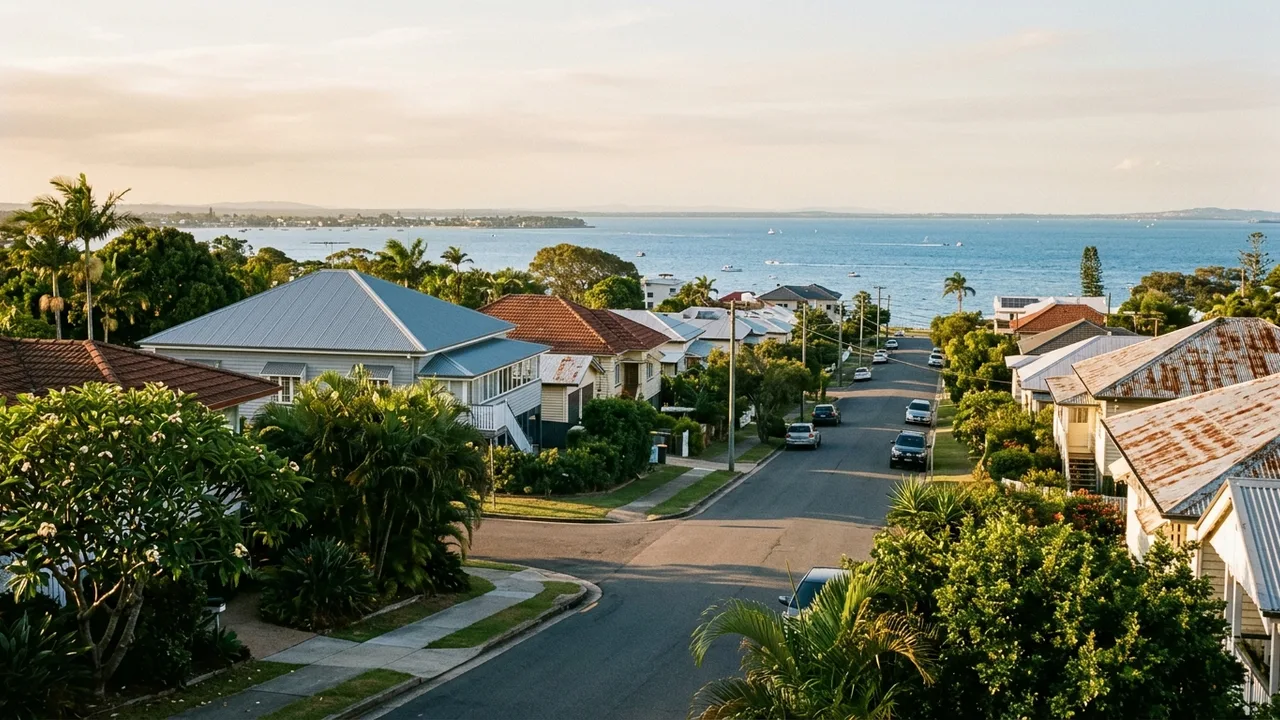
Prevailing wind direction matters too. Homes on the eastern or north-eastern faces of any hill or ridge catch more bay breeze directly. If your house faces Moreton Bay, your front roof slope likely ages faster than the back slope. Worth checking the next time you are up a ladder.
Comparing Roof Types: Which Holds Up Best?
No roofing material is immune, but they behave quite differently.
Colorbond steel with an intact factory coating performs well in coastal conditions because the coating itself seals the steel from salt contact. The weak points are cut edges, drill holes and screw penetrations. Once the coating is breached at any point, salt moisture finds steel and oxidation starts. A well-installed Colorbond roof with stainless or coated fixings, maintained and recoated before the substrate is exposed, can last decades even in Wynnum.
Older corrugated iron (pre-Colorbond era, common on Queenslanders built before the 1980s) is a different story. That material often has minimal protective coating remaining and may already be thinning at laps and ridges. In a bayside suburb, a mildly compromised iron roof deteriorates noticeably faster than the same roof in, say, Indooroopilly or Bardon.
Concrete tiles are robust but porous. Their factory sealer weathers off over ten to fifteen years in typical conditions; in coastal conditions, reseal timing probably needs to come forward by several years. Once the sealer is gone, the tile absorbs moisture and algae, lichen and moss establish quickly. Lichen is the one to watch: its root-like hyphae penetrate tile surfaces and can cause permanent pitting if left untreated.
Terracotta tiles are denser and less porous than concrete, which gives them an advantage in moisture absorption. However, their glazed surface does chip and craze over time, and cracked glaze opens the same pathway to salt-moisture damage that concrete tiles face from the start. Ridge mortar on terracotta roofs needs attention on the same schedule as concrete.
The Cost of Waiting (vs. the Cost of Acting)
This is where the bayside factor has the most practical consequence. The gap between "acceptable condition" and "active leak" is shorter near the water. A crumbling ridge cap that might give three or four more seasons inland might give one season in Wynnum.
A targeted repair, say, re-bedding and re-pointing ridge cappings on a standard suburban home, typically costs $600 to $1,500 depending on roof size and access. A full roof restoration, which includes pressure cleaning, replacing cracked tiles, re-bedding and pointing, and applying a quality protective coating, typically runs $3,000 to $8,000 for a standard four-bedroom home in the bayside suburbs. At the far end, large or complex roofs with significant existing damage can reach $10,000 to $12,000.
The numbers that tend to drive people to act quickly are the remediation costs that follow a roof leak: ceiling repairs, insulation replacement, potential mould remediation, and in older homes, damage to timber framing. Those costs can exceed the roof restoration cost on their own.
So the practical trade-off is this: spend a moderate amount now on maintenance and protective coating, or defer and risk a larger bill later that includes both the roof work and the internal damage it caused.
What a Sensible Maintenance Schedule Looks Like
If your home is within the Wynnum to Manly coastal strip, a reasonable framework is:
- Visual inspection from the ground every six months. Look for dislodged or cracked tiles, rust streaks on metal, and moss or dark algae growth. Binoculars help.
- Gutter check and clear twice a year, more often if you have large trees overhanging the roof. Blocked gutters cause moisture to back up against fascias, which is the fastest way to rot a fascia board.
- Professional inspection every two to three years. A roofer on the roof will spot loose ridge caps, cracked pointing, failing flashing seals and early-stage rust that simply cannot be seen from the ground or street.
- Pressure clean and reseal on a six to ten year cycle, depending on tile type and the condition of the existing coating. Concrete tiles need this more often than terracotta.
- Full restoration when the cumulative condition warrants it, not on a fixed schedule. An honest inspection will tell you where you sit.
One thing worth noting: a pressure clean alone, without a protective recoat, leaves tile surfaces clean but unsealed. In a coastal suburb, unsealed tiles will recolonise with algae and lichen faster than they would inland because the humidity and salt-enriched dew provide nutrients for growth. If you pressure clean, seriously consider sealing at the same time.
A Closing Word
Salt air does shorten the maintenance cycle for roofs in Wynnum, Manly, Lota and the surrounding suburbs. It is not alarmist to say that; it is just physics. The practical response is not panic, but it is not complacency either.
Get a clear-eyed look at your roof every couple of years from someone who knows what they are looking at. Not every roof needs full restoration. Some need a ridge re-point and nothing else. Some need a clean and seal. A few genuinely do need the full works.
If you would like to connect with a local roofer who works in the bayside suburbs and can give you an honest assessment of where your roof actually sits, that is something we can help organise through this service. No obligation to proceed, and the conversation is a useful one to have before the next storm season.
Quick answers