Roof Restoration guide
Tile Roof or Metal Roof Restoration: What Is the Difference?
Tile Roof or Metal Roof Restoration: What's Actually Different?
The process is different, the materials are different, and so is the cost. Tile restoration centres on re-bedding, re-pointing and recoating individual clay or concrete tiles, while metal roof restoration is mostly about treating corrosion, resealing laps and applying a flexible membrane coat. Same category of work, quite different execution.
If you're in Wynnum, Manly, Lota or anywhere else along the Bayside corridor, understanding which type of roof you have, and what restoration actually involves for that roof, saves you from paying for work you don't need or missing work you do.
What "Roof Restoration" Actually Means for Each Roof Type
Restoration is not a coat of paint slapped on top of old problems. Done properly, it's a systematic process that addresses whatever has deteriorated before any sealant or coating goes on.
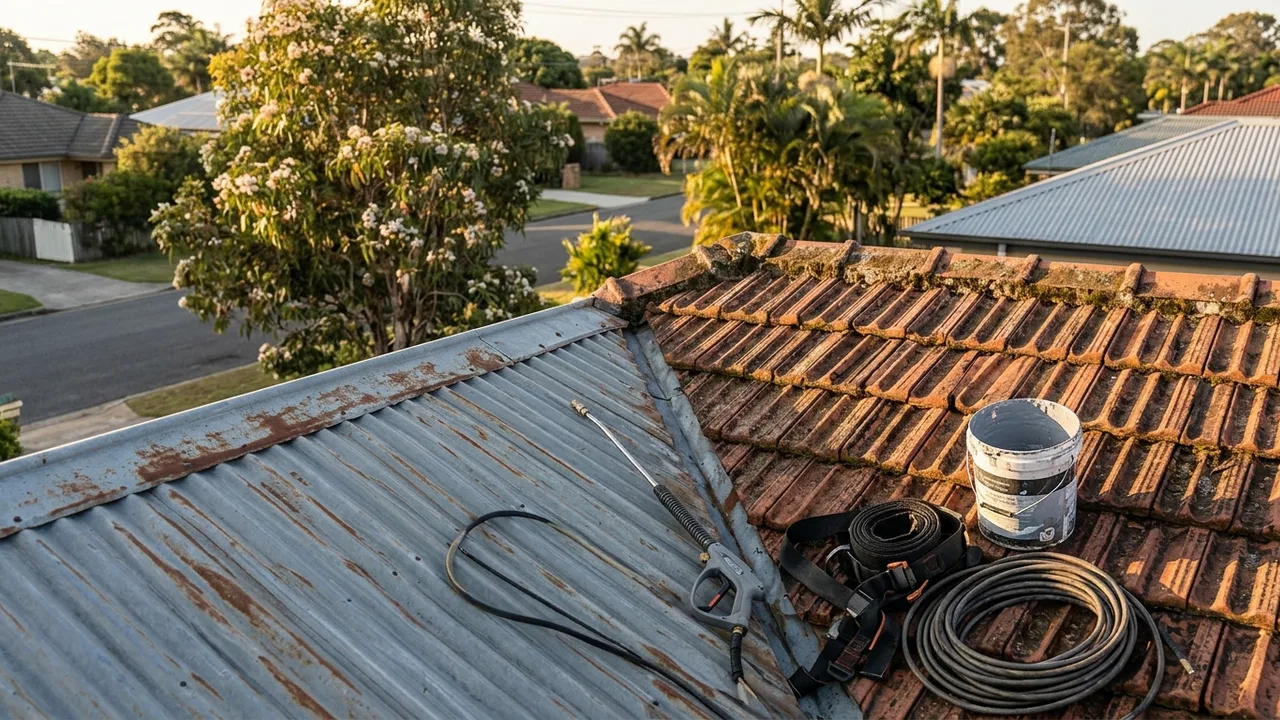
For tile roofs, a full restoration typically involves:
- A high-pressure clean to strip lichen, moss, dirt and old flaking sealer
- Replacing cracked or broken tiles
- Re-bedding and re-pointing the ridge caps (the mortar-bedded tiles along the apex of your roof)
- Applying a penetrating sealer or membrane coating to protect the tile surface
The ridge cap work is often the most critical part. On older Queenslander-era homes in the Wynnum area, rigid cement mortar pointing dries out and cracks over decades. Water gets in, the mortar bed softens, and caps start to shift. Left alone, you end up with tiles slipping, water getting into the ceiling cavity, and a much bigger repair bill.
For metal roofs, restoration follows a different logic:
- Pressure cleaning to remove surface contamination and loose rust
- Treating any rust spots with a rust converter or primer
- Resealing laps and penetrations (screws, vents, ridge flashings)
- Applying a flexible, elastomeric (rubber-based) coating that bridges small cracks and resists thermal movement
Metal roofs expand and contract a lot in Brisbane's heat. A rigid coating will crack along the laps and screw heads within a few seasons. That's why the coating product matters as much as the preparation.
The Condition Issues That Differ by Material
Tile roofs and metal roofs age differently, and the warning signs are distinct.
Tile roofs tend to show:
- Moss and lichen growth (very common in shaded yards in Wynnum West and Manly West where large trees hold moisture)
- Cracked, slipped or missing tiles, often after storms
- Crumbling or delaminating ridge pointing, which you might notice as loose white grit in the gutters
- Faded or porous tile surfaces that absorb water rather than shedding it
Metal roofs tend to show:
- Surface rust, particularly at laps, screw heads and any area where the coating has worn through
- Corrosion along gutters and valleys where water sits
- Lifting or popped screws that allow water to track under the sheet
- Lap joints opening up slightly as the sheeting moves over time
Bayside homes in Wynnum and Manly sit close enough to the water that salt air is a real factor for metal roofs. Salt accelerates corrosion, so a metal roof within a kilometre or two of the bay may need attention sooner than the same roof installed in, say, Hemmant or Wynnum West further inland. It's worth factoring that in when you're deciding whether to restore now or wait another year.
How the Cost Compares
Both tile and metal restorations for a typical detached Brisbane home typically fall somewhere in the $3,000 to $12,000 range, depending on roof size, condition and access. That range is wide, so here's how the variables break down.
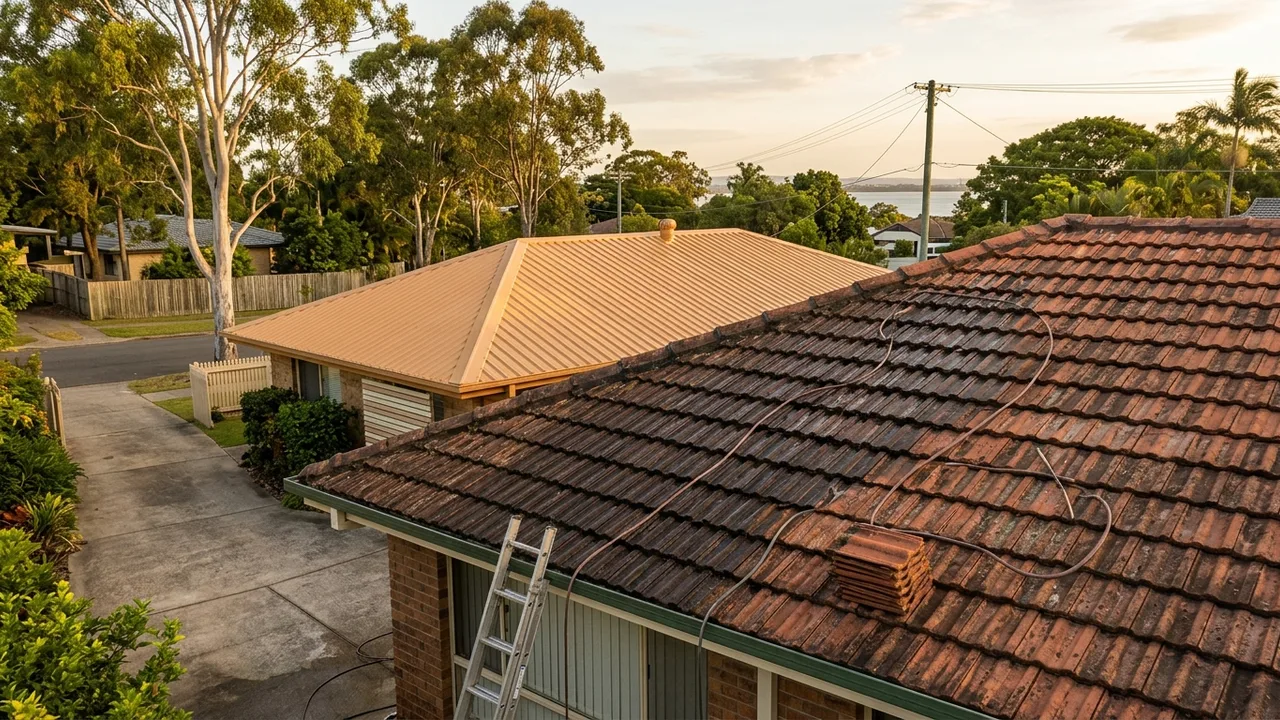
Tile restoration tends to cost more when:
- There are many cracked or missing tiles to replace
- Ridge capping needs extensive re-bedding (labour-intensive, not just material cost)
- The roof is steeply pitched or has multiple valleys and hips, adding access time
Metal restoration tends to cost more when:
- Rust is widespread and requires significant preparation before coating
- Previous coatings have been applied incorrectly and need to be removed or encapsulated
- The roof is an older corrugated iron style with many laps and penetrations to reseal
As a rule of thumb, metal restoration prep work (rust treatment and sealing) can add meaningful cost compared to a tile roof in equivalent condition, because surface treatment for metal is less forgiving of shortcuts. A poorly prepared tile coating might peel and look bad; a poorly prepared metal coating will fail at every rust spot and leak.
Can You Just Clean and Seal, or Is Full Restoration Necessary?
This is a fair question and the honest answer is: it depends on the age and current condition of the roof.
If your tiles are structurally sound, none of the ridges are loose and there's no cracking or slipping, then a pressure clean followed by a quality sealer might be all that's needed. That's a smaller job at a lower cost, and there's nothing wrong with it if the conditions are right.
Similarly, a metal roof that has minor surface oxidation but no active rust, sound laps and well-seated screws might be fine with a clean and a single-coat application.
Where people lose money is by choosing the cheaper option on a roof that actually needs the full scope. A sealer won't stabilise a shifting ridge cap. A coating won't stop a lap that's already letting in water. Getting a clear-eyed inspection first, ideally from someone who doesn't have a financial interest in recommending the bigger job, is genuinely worth the time.
What to Ask Before You Agree to Any Quote
Whether you're getting a quote on a tile or metal restoration, a few questions will tell you quickly whether the person in front of you knows what they're doing.
- What preparation work is included? If they plan to coat over existing moss, lichen or rust without treating it, that's a problem.
- What coating product are they using, and is it appropriate for your roof type? Rigid acrylics on a metal roof are a common mistake.
- Will the ridge caps be individually inspected? On a tile roof, this matters a lot. Some contractors quote for re-pointing without actually checking whether re-bedding is also needed.
- What warranty are they offering, and what does it actually cover? A warranty that only covers the coating material and not the labour to fix any failures is worth less than it sounds.
In the Wynnum to Manly corridor, salt air and storm exposure are real stressors on both roof types. A contractor familiar with the local environment should be able to speak to that specifically, rather than giving you a generic answer.
Which Restoration Is "Better"?
Neither is better in the abstract. Both can add 10 to 15 years to a roof's serviceable life when done properly. The right restoration is the one matched to your actual roof, in its actual condition, by someone who has properly assessed it.
If you have an older tile roof on a 1960s or 1970s Wynnum home that hasn't been touched in 20 years, full restoration including ridge work is almost certainly warranted. If you have a 15-year-old Colorbond or corrugated iron roof with surface oxidation and a few dodgy laps, a good clean, rust treatment and membrane coat may be all you need.
The mistake worth avoiding is treating restoration as a cosmetic exercise. The coating is the visible part, but the prep work and repairs underneath it are what determine whether the job holds up through the next Bayside storm season.
If you'd like to talk through what you're seeing on your own roof, we connect homeowners across Wynnum, Manly, Lota, Hemmant, Manly West and Wynnum West with local contractors who can give you a straight assessment. No obligation to proceed.
Quick answers